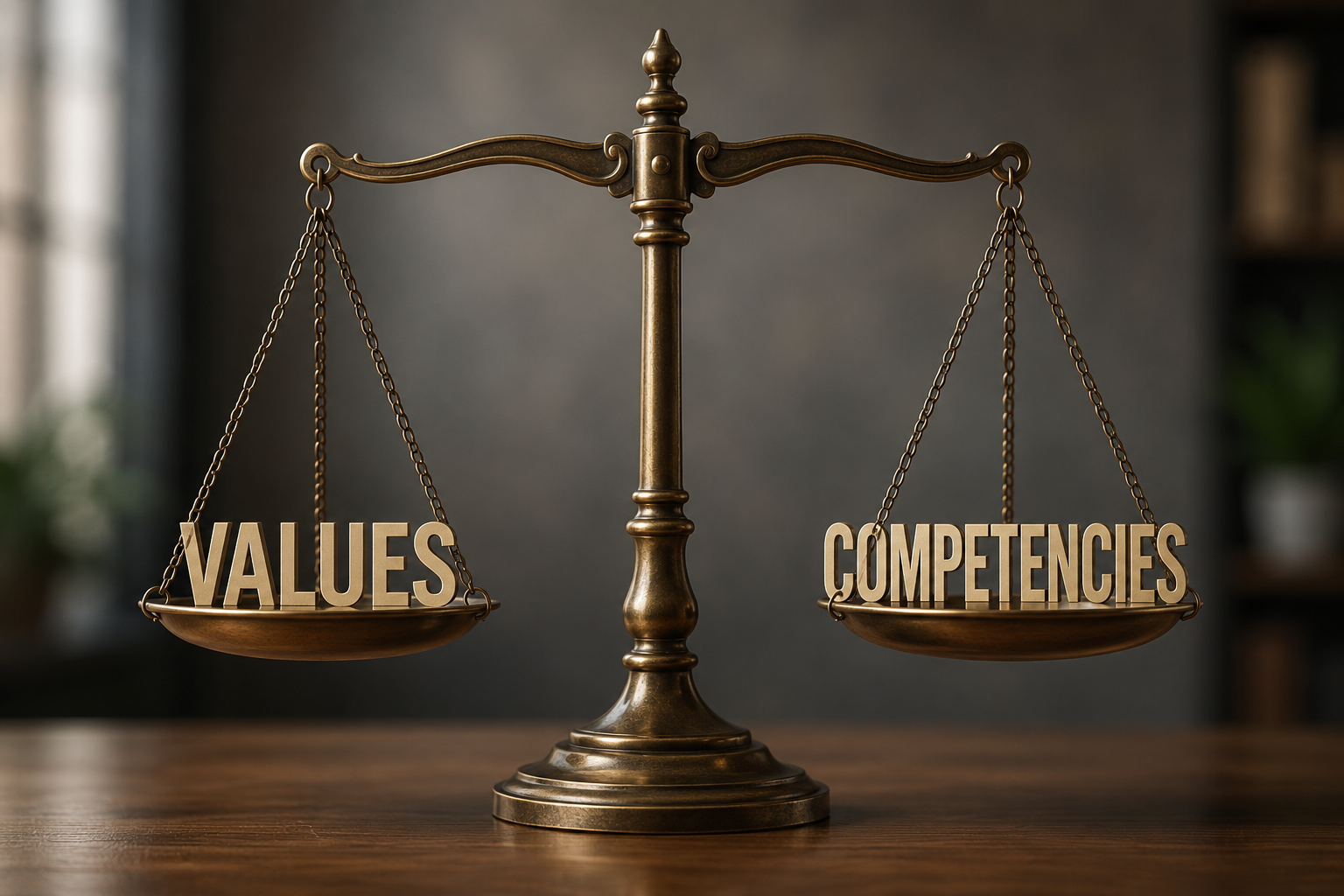
In many organisations, company values are clearly defined, but they often remain abstract statements on a website or a slide deck. At the same time, leadership competency models describe the behaviours leaders are expected to demonstrate. When these two elements are not aligned, organisations risk sending mixed signals about what truly matters.
Aligning leadership competencies with company values ensures that leadership behaviour reflects the organisation’s culture and strategic direction. It helps transform values from words into everyday actions.
Here, we explore why this alignment matters and how organisations can effectively integrate their values into leadership competency frameworks.
When leadership competencies reflect company values, organisations gain several important advantages.
1. Values become actionable
Values often describe ideals—such as collaboration, innovation, or integrity. Leadership competencies translate these ideals into observable behaviours that leaders can practice and develop.
2. Consistency across the organisation
Leaders set the tone for organisational culture. When leadership competencies reinforce company values, employees see consistent examples of how those values should guide decisions and interactions.
3. Stronger leadership development
Development programs become more meaningful when they focus on behaviours that directly support the company’s culture and strategy.
4. Better feedback and evaluation
Alignment allows organisations to evaluate leaders not only on results, but also on how those results are achieved.
1 Clarify and Prioritise Company Values
The first step is ensuring that company values are clearly defined and meaningful.
Many organisations list values such as:
- Integrity
- Collaboration
- Innovation
- Customer focus
- Accountability
However, values need to be more than aspirational words. Each value should have a clear description that explains what it means within the specific organisational context.
For example:
Innovation might mean:
- Encouraging experimentation
- Challenging existing processes
- Learning from failures
Collaboration might mean:
- Sharing knowledge across teams
- Actively seeking diverse perspectives
- Supporting collective success rather than individual competition
Clarifying these meanings provides a foundation for defining leadership behaviours.
2 Translate Values into Leadership Behaviours
Once values are clearly defined, the next step is translating them into concrete leadership competencies.
This involves asking a simple but powerful question:
“What should leaders do differently if they truly live this value?”
For example:
Company Value: Integrity
Leadership Behaviour: Communicates transparently and follows through on commitments
Company Value: Collaboration
Leadership Behaviour: Encourages cross-functional cooperation and recognises team contributions
Company Value: Innovation
Leadership Behaviour: Creates a safe environment for experimentation and new ideas
Company Value: Accountability
Leadership Behaviour: Takes responsibility for decisions and holds others to clear standards
These behaviours can then be integrated into the leadership competency model.
3 Integrate Values into Leadership Competency Frameworks
Many organisations already have leadership competency models that include skills such as:
- Strategic thinking
- Decision making
- Communication
- Team development
To align these competencies with company values, organisations can integrate value-based behaviours into each competency.
For example:
Competency: Strategic Leadership
Aligned value: Customer focus
Behaviour example: Ensures strategic decisions prioritise long-term customer value.
Competency: People Development
Aligned value: Collaboration
Behaviour example: Builds inclusive teams where diverse perspectives are encouraged.
This ensures that leadership capabilities reinforce the organisation’s culture.
4 Embed Alignment into Leadership Development
Alignment only becomes meaningful when it is embedded into everyday leadership practices.
Organisations should integrate value-based competencies into:
- Leadership development programs
- Coaching and mentoring
- Performance evaluations
- Promotion and succession decisions
Development activities can focus on helping leaders reflect on how their behaviours support (or sometimes unintentionally contradict) organisational values.
Practical tools such as leadership assessments or 360 degree feedback can provide valuable insight into how leaders demonstrate these behaviours in practice.
5 Use Feedback to Reinforce Value-Based Leadership
Feedback is essential for ensuring leadership competencies truly reflect company values.
Tools like leadership assessments or 360-degree feedback help organisations evaluate whether leaders are demonstrating the expected behaviours.
For example, feedback questions may explore areas such as:
- Does the leader encourage open dialogue and collaboration?
- Does the leader act consistently with the organisation’s values?
- Does the leader create an environment where new ideas are welcomed?
These insights allow leaders to better understand how their actions influence the culture around them.
Creating a Culture Where Values Guide Leadership
Ultimately, aligning leadership competencies with company values helps organisations move from stated values to lived values.
When leaders consistently demonstrate behaviours that reflect the organisation’s principles, values become part of everyday decision-making, communication, and collaboration.
This alignment strengthens trust, supports cultural consistency, and ensures leadership development contributes to the long-term success of the organisation.
Organisations that successfully integrate their values into leadership competencies create a powerful foundation for sustainable growth, where culture and leadership work together to achieve strategic goals.